



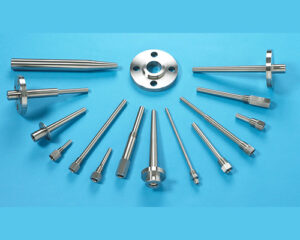
Three main features are considered for thermowells:
- High resistance and durability: In addition to resistance to heat and corrosion, high durability is also of particular importance. One of the main goals of a thermowell is to reduce production costs. On the other hand, producing a thermowell itself will have a cost. Therefore, each thermowell must have a cost reduction of at least several times its price. For this reason, a thermowell must be able to be used again and again.
- Special thermodynamic properties: The thermowell must be such that the thermocouple inside it can measure the temperature of the furnace in the most accurate way. If it causes heat transfer in a continuous oscillating manner, meaning that it shows the temperature transferred to the thermocouple differently at every moment, it will be more harmful than beneficial.
- Least interference: The presence of anything in the flow of a fluid changes its movement pattern, and the thermocouple sheath, which is placed exactly in the flow of the fluid with the thermocouple inside it, must cause the least interference. For example, its constituent materials should not react with the fluid in the flow, and its morphology should not create eddy currents or other similar pattern changes.
- Ease of use: You can easily install or remove the thermowell without performing complex steps and without the need for special and trained personnel. And this will not be time-consuming. For this reason, it will be very easy to use.
Steps to purchase and order a thermowell
Any industrial unit that needs this equipment must first register an order for its manufacture at Petropolad Middle East. During the order registration process, precise details of the raw materials required to manufacture this part must be made available to experts. Because some of the raw materials must be purchased from foreign manufacturers and imported into the country.
Necessary information such as the type of employer’s need, the factories producing the materials
The initial proposal is presented to the employer in accordance with his needs in the manufacturing countries and their different prices and qualities. After reaching a consensus, Petropolad itself initiates correspondence and goes through the steps of purchasing the required raw materials and flanges. Since these items require mandatory standards in the clearance process, this can normally be very time-consuming and difficult, but Petropolad traders carry out these processes completely routinely after 15 years of work.
Custom Thermowell Manufacturing
The received raw materials are first marked according to specialized drawings drawn by Petropolad engineers and then cut with special nickel-based alloy cutting tools and are prepared for the next stage. At this stage, the workshop environment is completely isolated and free of any other materials, including steel. Then, before starting the WPS of the Thermowell, items such as the location and position of the welds, etc. are inspected by the inspector. Also, only welders with a 5G grade are used in this work. Then, in addition to checking the validity of their certificate, several samples of welding with the same material are taken from them. Finally, considering the telescopic nature of the part and the need for two-stage manufacturing, the continuation of the steps for welding in the factory is coordinated with the employer.
Thermocouple sheath quality control – Thermowell
Thermowell quality control is carried out in three stages by Petropolad Middle East.
- Inspection after preparation of raw materials: At this stage, the thermowell is examined in very important dimensions. Dimensional control, chemical analysis, destructive mechanical testing of tension, strain and fracture are among the most important. Finally, a comprehensive visual inspection is also carried out.
- Before preparation of raw materials: After the materials are cleared and transported to the workshop, a chemical test is taken to ensure the required composition and the authenticity of the product. Then, all measurements and markings made by engineers that have been applied to the cutting and turning of the work are inspected.
- Post-manufacturing inspection: Finally, after completing all stages of product production (which has also undergone brief stages of inspection during the production stages), all welds and weld lines will be subjected to various non-destructive tests, including VT and PT, by a trusted inspection company selected by the employer.
